Planning a wedding involves plenty of choices, but deciding why have two photographers at a wedding is often easier when you look beyond the number of final images. The real benefit is not simply getting more photographs. It is having broader coverage when important moments happen at the same time, in different places, or only once.
TL;DR: Two photographers are most valuable when your wedding has separate getting-ready locations, a large or spread-out venue, a tight timeline, 80+ guests, travel between locations, or moments you do not want to risk missing. One photographer can still be an excellent fit for a smaller, simpler day with one venue and a relaxed schedule.
What two wedding photographers actually change
Two photographers create parallel coverage. Instead of one person constantly moving between rooms, guests, portraits, and ceremony positions, each photographer can focus on a different part of the day.
That distinction matters because weddings are full of non-repeatable moments. A parent seeing wedding attire for the first time, a partner arriving at the ceremony, tears during vows, or a spontaneous dance-floor reaction cannot always be recreated later.
Broader coverage without constant rushing
A second photographer gives the lead photographer more room to work deliberately. One person can photograph couple portraits while the other covers guests arriving at cocktail hour, family hugs, venue details, or candid conversations.
Katie Mortimore explains that two photographers can reduce rushing, cover separate preparation locations, and help coordinate venue or ceremony rules. That can be particularly useful when a registrar, church, or venue has clear restrictions about where photographers may stand.
The practical advantage is simple: less movement can mean less interruption. Rather than crossing the room during vows or leaving cocktail hour to start portraits, the team can divide responsibilities before the day begins.
Different viewpoints tell a fuller story
A wedding ceremony happens in a few minutes, but it contains several stories at once:
• One partner walking down the aisle
• The other partner’s reaction
• Parents and guests responding emotionally
• The wider setting, décor, and atmosphere
• The exchange of vows, rings, and first kiss
A single photographer can capture many of these moments. Two photographers make it more realistic to capture them at the same time from complementary positions.
The Knot notes that two wedding photographers can provide broader coverage, more moments, and more images overall. The more useful way to interpret that point is not “twice as many photos.” It is “fewer meaningful choices between competing moments.”
A second photographer is not just an extra camera
The lead photographer is usually responsible for the overall visual direction, key portraits, timeline awareness, and final creative consistency. A second photographer works alongside that lead, capturing assigned angles, candid moments, details, or simultaneous events.
An assistant is different. An assistant may help carry equipment, set up lighting, manage family groupings, or solve practical issues, but may not be hired to photograph the day independently.
|
Role |
Main responsibility |
Usually takes photos independently? |
Best use |
|---|---|---|---|
|
Lead photographer |
Directs coverage, portraits, timeline, and overall approach |
Yes |
Every wedding photography booking |
|
Second photographer |
Covers assigned moments, angles, guests, and parallel events |
Yes |
Complex, large, or split-location weddings |
|
Assistant |
Supports equipment, lighting, organization, and logistics |
Not always |
Weddings needing extra practical support |

A bride and groom share a joyful dance at their wedding, surrounded by clapping guests. The images show different angles of the couple’s embrace on the dance floor. Wedding Photo taken by Jennings Photography
When two photographers are worth the extra cost
There is no universal guest-count rule that makes two photographers essential. Research and industry guidance do not provide a tested numeric threshold. Still, certain conditions make one photographer more likely to be stretched.
Use this decision framework
A second photographer is usually worth considering when two or more of the following conditions apply.
|
Wedding condition |
Why it increases coverage risk |
Two-photographer value |
|---|---|---|
|
Partners get ready in separate locations |
Important preparation moments overlap |
Each photographer can cover one location |
|
Ceremony and reception are far apart |
Travel time can remove coverage opportunities |
One photographer can move ahead or remain with guests |
|
Large venue with multiple rooms |
It is harder to see reactions and activity across the space |
Coverage can be divided by area or event |
|
Guest list of roughly 80+ |
More guest interactions happen simultaneously |
More candid and family coverage becomes possible |
|
Tight portrait schedule |
Portraits can overlap with cocktail hour or reception activity |
One photographer handles portraits while one stays with guests |
|
Complex ceremony rules |
Limited movement can restrict angles |
Photographers can use planned positions |
|
Multiple cultural events or traditions |
Several meaningful moments may overlap |
Roles can be allocated in advance |
Copper and Blossom Photography highlights that two photographers are especially helpful when preparations happen in different locations or the day includes travel between venues. This is one of the clearest reasons to book a second photographer.
For example, imagine one partner getting ready at home in Colchester while the other is preparing at a hotel near the ceremony venue. A single photographer must choose one location, divide the coverage unequally, or spend part of the morning travelling. Two photographers remove that forced choice.
When one photographer can be enough
Two photographers are not automatically better for every wedding. A skilled solo photographer can provide excellent coverage when the day is compact and expectations are clear.
One photographer may be a sensible option when:
• Both partners prepare at the same venue or do not need extensive getting-ready coverage
• The ceremony, drinks reception, meal, and evening celebration happen in one compact location
• The guest list is small and the schedule includes generous gaps
• You prioritize a simple documentary approach over extensive guest and detail coverage
• Your budget is better allocated to longer coverage, an album, or another priority
The key question is not “Is a second photographer a luxury?” Ask instead: Where would one person have to make a choice between two meaningful moments? If the answer is “nowhere,” one photographer may be enough.
The situations where coverage risk matters most
The strongest case for two photographers is often about risk reduction rather than image quantity. A wedding does not pause while someone changes position, works around a crowded room, or travels between locations.
J. La Plante Photo describes a second photographer as practical backup coverage that can help divide tasks during key wedding moments. This does not mean a second photographer replaces preparation, reliable equipment, or a well-planned timeline. It means the team has more coverage options when a once-only moment unfolds unexpectedly.
Consider these examples:
• A grandparent begins an emotional conversation with the couple while formal portraits are underway.
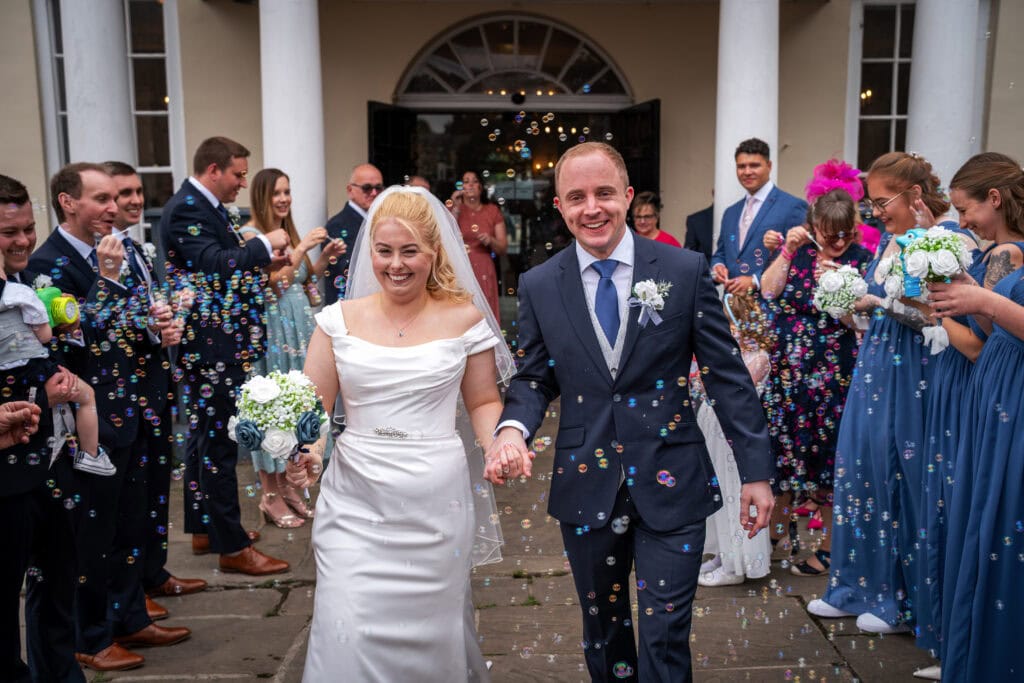
• The wedding party enters the reception as guests are reacting from multiple tables.
• A ceremony has restricted aisle access, making it difficult for one photographer to photograph both the entrance and the waiting partner’s reaction.
• Rain changes the portrait location at short notice, while guests begin cocktail hour indoors.
In each case, two photographers can divide attention rather than trying to recreate moments later.
How a two-photographer team can divide the day
The best results come from a clear plan, not from both photographers taking the same picture from the same spot. A well-organized team assigns priorities while leaving room for spontaneous moments.
A practical shot-allocation model
The table below shows one useful way to divide responsibilities. The exact plan should change around your timeline, venue rules, family needs, and priorities.
|
Part of the day |
Lead photographer focus |
Second photographer focus |
Why the split works |
|---|---|---|---|
|
Getting ready |
One partner, key details, timeline |
Other partner, family interactions, alternate details |
Covers separate preparations without travel pressure |
|
Arrival and ceremony |
Main aisle view, vows, ring exchange |
Partner reactions, guest reactions, wider scene |
Captures simultaneous emotion from separate positions |
|
Family photographs |
Directing groups and formal portraits |
Candid guests, children, venue atmosphere |
Keeps coverage moving while groups are organized |
|
Couple portraits |
Main portrait direction |
Wider frames, behind-the-scenes candids, guest activity |
Reduces the chance of missing cocktail-hour moments |
|
Reception entrance |
Main entrance and couple reaction |
Guest response and room-wide perspective |
Documents both action and audience |
|
Speeches |
Speaker and couple reaction |
Parents, wedding party, table reactions |
Preserves the emotional exchange |
|
Dance floor |
Main action and key moments |
Guest candids and alternate angles |
Adds variety without duplicating every frame |
Dave McIntosh Photo notes that two photographers can split duties across portraits, guests, and reception coverage to increase variety and reduce missed moments. This approach is especially useful when portrait time overlaps with drinks reception or when guests are spread across indoor and outdoor areas.
How two photographers can be less intrusive
It may seem counterintuitive, but two photographers can sometimes make photography feel less disruptive. The goal is not to surround every moment with cameras. It is to reduce unnecessary movement.
For a ceremony, one photographer might stay near the front before proceedings begin, while the other uses a discreet rear or side position. This limits the need to cross aisles or move prominently during vows.
For portraits, one photographer can direct the couple while the other works quietly at a distance, capturing natural transitions rather than interrupting the flow with repeated pose changes.
That said, this only works if the photographers coordinate their positions. Two unplanned photographers can create clutter, block guest views, or duplicate images. Clear responsibility is what turns extra coverage into better coverage.
Build the timeline around real travel time
A timeline often looks workable on paper until travel, parking, access, family coordination, and weather are added. If your day includes multiple locations, leave realistic buffers rather than assuming photographers can move instantly between them.
For a practical planning reference, the ultimate timeline for your wedding photography can help you identify where preparation, portraits, travel, and guest coverage may overlap.
Quality, consistency, and possible downsides
A second photographer can broaden the final gallery, but it also introduces a few decisions worth making carefully. More coverage does not guarantee a stronger result if the team is poorly matched or the plan is unclear.
Check for a genuine style match
A cohesive wedding gallery should feel intentional from beginning to end. The photographers do not need identical creative instincts, but their approach to light, composition, guest interaction, and editing should work together.
Before booking, ask to see a full wedding gallery that includes photographs from both photographers. Do not judge only a highlights page. A full gallery shows whether ceremony images, family photos, candid moments, and evening coverage feel consistent.
Use this short quality check:
- Ask whether the same second photographer is expected to attend your wedding.
- Ask who edits the final gallery and how consistency is maintained.
- Review images from similar lighting conditions, especially dark reception spaces and indoor ceremonies.
- Ask how duties will be divided during preparation, portraits, speeches, and dancing.
- Confirm whether the second photographer is an experienced shooter or primarily an assistant.
For more selection questions, see top tips for choosing your perfect wedding photographer.
Understand the tradeoff between breadth and curation
Two photographers may produce a wider range of images, including alternate angles and more guest reactions. The editing process then matters even more. A thoughtful final gallery should feel curated, not repetitive.
|
Potential advantage |
Possible downside |
What to ask |
|---|---|---|
|
More ceremony angles |
Similar images can become repetitive |
How are duplicate frames selected and removed? |
|
More guest coverage |
Style differences may show in the gallery |
Who handles colour correction and final editing? |
|
Better split-location coverage |
Extra cost may not fit a simple schedule |
Which specific timeline problem does the second photographer solve? |
|
Backup during key moments |
Two people need coordinated positioning |
How are ceremony positions planned? |
|
Faster coverage across a large venue |
More photographers can feel noticeable if unmanaged |
How do you work discreetly around guests and venue rules? |
Fair warning: if your day is small, relaxed, and entirely in one location, the added cost may not produce enough additional value to justify it. The goal is not to book more coverage because it sounds impressive. The goal is to choose coverage that matches your day.
Frequently Asked Questions: Two photographers at a wedding
Is a second wedding photographer worth the extra cost?
A second photographer is usually worth the cost when there are overlapping events, separate preparation locations, significant travel, a large guest list, or a venue with multiple active spaces. It may be less worthwhile for a small wedding in one compact venue with a flexible timeline.
Do two photographers mean more photos or just duplicate coverage?
They can mean more photos, but the better outcome is broader coverage. A planned team captures different parts of the story: one photographer may photograph the speaker during a toast while the other captures the couple’s reaction and the response from family members.
Can one photographer cover both partners getting ready?
Sometimes, especially when both partners are at the same venue or have staggered preparation times. If they are getting ready far apart at the same time, one photographer will usually need to choose one location or limit coverage at both.
What size wedding benefits most from two photographers?
There is no evidence-based number that applies to every wedding. As a practical guide, weddings with around 80 or more guests often create more simultaneous candid moments, but venue size, room layout, travel, and timeline complexity matter just as much as guest count.
How do two photographers handle the ceremony without getting in the way?
They should agree on positions before the ceremony and work within venue rules. One may cover the main action from the front or side, while the other photographs wider views and guest reactions from the rear. Good coordination reduces unnecessary movement.
Will two photographers make the wedding album better?
Potentially, because the album can include more reactions, context, and alternate views of key moments. It will only feel better if the images are consistently edited and carefully selected. More files alone do not create a stronger album.
Is two photographers overkill for a small wedding?
It can be, particularly for a short wedding with fewer guests in one small venue. It may still be useful if the couple gets ready separately, the ceremony has strict movement rules, or portraits overlap with important guest time.
Sources and References
• The Knot — Should You Have Two Wedding Photographers? Find Out Expert Advice on Whether You Need One or Not: https://www.theknot.com/content/second-wedding-photographer-do-you-need-one
• Katie Mortimore — Wedding Photographers – Are two better than one?: https://katiemortimore.com/wedding-photographers-two-better-one/
• Copper and Blossom Photography — Why do you need two photographers at a wedding?: https://www.copperandblossom.co.uk/blog/why-do-you-need-two-photographers-at-a-wedding
• Dave McIntosh Photo — Do I Need a Second Photographer at My Wedding: https://davemcintosh.com/do-i-need-a-second-photographer-at-my-wedding/
• J. La Plante Photo — Two Wedding Photographers or One?: https://jlaplante.com/two-wedding-photographers-or-one/