Planning how to keep wedding photographs from taking over the day is not about treating photos as an afterthought. It is about giving them a clear place in the schedule, then protecting the ceremony, the meal, and the time you actually want to spend with your guests.
I recommend building the photography plan around the moments that cannot move, such as ceremony access, catering service, venue room turnover, and sunset. Portraits then fit into the available windows rather than quietly expanding until guests are waiting and the reception is running late.
A good photo plan should make space for meaningful portraits while allowing the wedding to still feel like a celebration, not a continuous photo session.
Key Takeaways
Protect the non-negotiable parts of the day
Start with the ceremony, meal service, speeches, venue access limits, and sunset. These are the fixed points. Photography should work around them, with a firm end time for each portrait block.
Prioritise rather than trying to photograph everything
Use three levels for requested images:
• Must have: Images you would genuinely regret missing.
• Nice to have: Meaningful photos that are useful if time allows.
• Optional: Extra combinations, locations, or poses that can be skipped without changing the story of the day.
This simple ranking gives everyone a sensible decision rule if the schedule slips.
Build photography around the day, not the other way around
Start with venue and catering constraints
A photography timeline can look generous on paper but still fail when it ignores how the venue operates. Ask about the ceremony start window, room reset times, when dinner must be served, access to outdoor areas, and any curfews or restrictions on specific spaces.
For example, a venue may need the dining room clear for a reset just as you planned indoor family photographs there. Or dinner service may be timed tightly enough that a 20 minute overrun pushes speeches, sunset portraits, and the first dance later into the evening.
I suggest listing these constraints before deciding when to take portraits. This makes it easier to identify photo windows that are genuinely usable, rather than assuming every gap in the day is free.
Give every photo block a start and stop time
A broad note saying “photos after the ceremony” leaves too much room for drift. A micro timeline is more useful because it tells everyone when the next activity must begin.
| Photo block | Example purpose | Protect it with |
|---|---|---|
| Pre-ceremony portraits | Couple, wedding party, details | Private getting ready space and travel allowance |
| Immediately after ceremony | Family groups and wedding party | A named meeting point and a hard finish time |
| Cocktail period | Couple portraits and candid guest coverage | A short route with no unnecessary location changes |
| Near sunset | A few outdoor couple portraits | A flexible window before daylight fades |
| Reception | Candid moments, speeches, dancing | Coordination with the MC, DJ, and planner |
The exact length of each block depends on the size of the wedding, venue layout, travel distance, and number of requested group combinations. There is no universal timing rule that fits every celebration. What matters is that each block has a clear end point.
For a more detailed structure, use the ultimate timeline for your Essex wedding photography as a planning companion.
Add buffer time where delays actually happen
Buffer time is not empty time. It is the space that prevents one late moment from affecting the entire day.
I recommend adding a buffer around:
• Hair and makeup finishing later than expected
• Travel between preparation, ceremony, and reception locations
• Guests leaving the ceremony space slowly
• Family members finding the group-photo meeting point
• Dress adjustments, bathroom breaks, confetti, hugs, and venue transitions
• Speeches or meal service running longer than planned
A useful rule is to place buffer between major blocks rather than only at the end of the day. If all the spare time sits before the first dance, it cannot help when preparations run late in the morning.

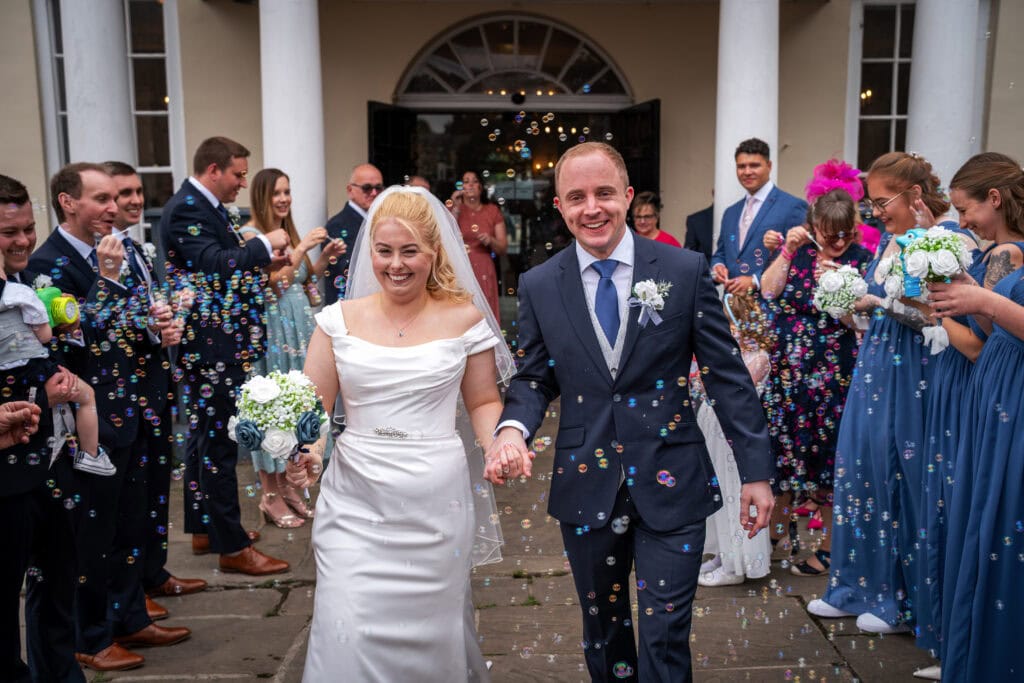
A bride and groom walk hand in hand outdoors, smiling as guests throw confetti. The bride holds a bouquet of white flowers, and both are dressed in formal wedding attire.
Keep Group Photos Efficient and Guests Included
Limit group photos by decision, not guilt
Family photographs matter, especially when relatives have traveled or when generations are together. The issue is rarely group photos themselves. The issue is an unranked list that grows until every combination feels equally urgent.
Choose groups based on relationships, not on a wish to create every possible variation. A photograph with each set of parents, siblings, grandparents, and key family members may be essential. Several versions of the same group with minor changes may be optional.
| Priority level | Include these photos | Cut first if behind schedule |
|---|---|---|
| Must have | Parents, siblings, grandparents, children, immediate wedding party | Do not cut unless necessary |
| Nice to have | Extended family groups, godparents, close friends | Reduce duplicate combinations |
| Optional | Multiple pose variations, distant relatives, separate informal pairings | Skip or capture candidly later |
Fair warning: it is easier to add an optional photo later than to recover 20 minutes once guests are waiting for drinks, dinner, or the couple’s arrival.
Use a family wrangling protocol
A family wrangler is one trusted person who knows the important relatives and is comfortable giving clear directions. This person should not be the couple, a parent needed in every picture, or someone likely to disappear for a drink after the ceremony.
Give them a simple protocol:
- Share the final group list before the wedding day.
- Name one meeting point close to the ceremony exit or photo location.
- Ask key relatives to remain nearby immediately after the ceremony.
- Call the next group while the current group is being photographed.
- Tell the wrangler which combinations can be skipped if time is short.
This approach prevents the familiar delay of searching for an uncle who has wandered off just as everyone else is assembled.
Let multiple photographers create a smoother flow
Hiring multiple photographers can help group photos move more smoothly when the team works as one coordinated unit. One photographer can take the current group while another helps identify the next people needed, checks that clothing and flowers are ready, or continues capturing candid guest moments nearby.
This is most useful when:
• The group list is substantial but tightly prioritized
• The venue has a clear nearby meeting area
• There are many guests who may not know one another
• The couple wants candid cocktail-hour coverage while formal photos happen
Multiple photographers are not a reason to create twice as many posed combinations. They are most effective when they reduce waiting, repeated instructions, and interruptions.

A bride in a white lace wedding dress and a groom in a gray suit holding hands and smiling at each other while walking indoors. Wedding Photo taken by Jennings Photography
Keep Portraits Relaxed Without Losing the Important Images
Choose the right balance of documentary and posed coverage
Documentary coverage focuses on real interactions, unfolding events, and unprompted reactions. Posed coverage gives you intentional family portraits, wedding party images, and couple photographs where everyone is visible and settled.
| Approach | Best for | Timing effect | Watch for |
|---|---|---|---|
| Mostly documentary | Couples who want to stay immersed with guests | Fewer interruptions throughout the day | Important family combinations may need clear planning |
| Balanced coverage | Couples wanting candid moments plus key portraits | Short planned portrait blocks | Requires a ranked group list |
| More editorial or posed | Couples prioritizing styled images and direction | Longer or more frequent portrait sessions | Can reduce guest time if not scheduled carefully |
Neither approach is automatically better. The right choice depends on what you want to remember. If you want the day to feel less interrupted, agree on a shorter list of directed photographs and allow candid coverage to carry more of the story.
The distinction is worth discussing before booking or planning your shot list. This guide to editorial vs documentary wedding photography can help you decide how much direction feels right for you.
Group locations to reduce context switching
Moving repeatedly from one location to another adds more than walking time. It requires gathering people, adjusting clothing, resetting attention, and helping everyone understand what happens next.
I recommend creating a simple sequence:
- Take formal family photos in one nearby location.
- Photograph the wedding party before sending them to cocktail hour.
- Take a focused couple portrait block along one short route.
- Return the couple to guests before the reception begins.
- Use a brief sunset window later only if the light and schedule allow.
For instance, walking to a distant garden for “just a few photos” may turn into a much longer absence once the wedding party joins, guests stop the couple for congratulations, and everyone walks back. Choose locations that are beautiful and practical.
Decide What Needs Daylight and What Can Wait
Reserve daylight for photos that depend on the setting
Not every image needs to happen before sunset. Candid reception photos, dancing, speeches, cake cutting, and many indoor portraits can be photographed in lower light with appropriate planning. Outdoor group portraits and scenic couple photographs are usually harder to recreate once daylight has gone.
| Photo type | Daylight priority | Why |
|---|---|---|
| Outdoor family groups | High | Faces, larger groups, and the setting are easier to photograph clearly |
| Scenic couple portraits | High | The surroundings and natural light are part of the image |
| Wedding party portraits | Medium to high | Depends on group size and desired location |
| Speeches and dancing | Lower | These naturally happen later and can be covered in reception lighting |
| Candid guest interactions | Flexible | Can happen throughout the day and evening |
If sunset is early, plan the essential outdoor portraits earlier. If the ceremony ends close to sunset, a first look or pre ceremony portraits may be worth considering.
Consider a first look only when it solves a real problem
A first look is a private moment before the ceremony when the couple sees each other and may complete some portraits early. It can relieve pressure after the ceremony, but it is not required for a calm photography experience.
Choose a first look when:
• Daylight will be limited after the ceremony
• The reception timetable leaves little room for portraits
• You want to attend most of cocktail hour together
• You are comfortable seeing each other before the aisle moment
Avoid it when preserving the first aisle reveal matters more to you than gaining extra portrait time. In that case, keep the post ceremony plan concise: family groups first, wedding party next, then a short couple session before joining guests.
Share the plan with the people who control the pace
Your photographer needs more than a general shot list. Share the ceremony timing, group-photo priorities, family dynamics that may affect gathering people, key events, venue restrictions, and the people who can make decisions if you are unavailable.
Ask these questions in advance:
• What is the hard stop for family and couple portraits?
• Which portraits are essential before sunset?
• Who will gather family members?
• Where will each group meet?
• What happens if the ceremony or meal runs late?
• Who approves skipping optional photos?
If you are not sure what to cover in that conversation, top 10 questions to ask your wedding photographer offers a useful starting point.
Have a Recovery Plan for Delays
Agree on cut rules before the wedding
A delay is much easier to manage when nobody has to make emotional decisions in the moment. Before the day, decide what changes first if time is lost.
| If this happens | Protect | Cut or adjust first |
|---|---|---|
| Ceremony starts late | Immediate family photos and meal timing | Optional group combinations |
| Family members are missing | The groups already assembled | Individual requests for absent relatives |
| Travel takes longer than planned | Couple arriving before dinner or reception entrance | A distant portrait location |
| Sunset arrives early | Essential outdoor couple photos | Extra pose variations |
| Speeches run over | Key reception events | Nonessential evening portraits |
The couple, photographer, and coordinator should know this order. It keeps the decision practical rather than personal.
Use a hard stop for portrait time
A hard stop is the point when portraits end, even if the optional list is unfinished. This protects guest experience and prevents a small delay from becoming a late meal, rushed entrance, or missed reception moment.
A hard stop works best when you have already ranked the photos. Without priorities, stopping can feel like failure. With priorities, it simply means you completed the images that mattered most.
Leave room for a short reset
Wedding days move quickly. Build in a few minutes after the main portrait block for water, a quiet breath, clothing adjustments, or simply walking into cocktail hour together. This is not wasted time. It helps the next part of the day feel intentional instead of hurried.

A bride and groom in formal attire walk hand in hand on a path through a garden, smiling at the camera.
Frequently Asked Questions
How long should wedding photos realistically take?
The answer depends on the number of group combinations, the distance between locations, daylight, venue access, and how much posed coverage you want. Rather than choosing a fixed duration first, identify the required photographs and the nonnegotiable schedule points. Then give each block a start and stop time, with buffer between activities.
A small family list in one location may move quickly. A long list spread across several parts of the venue will take longer because gathering and moving people often takes more time than pressing the shutter.
How many group photos is too many?
There is no single number, but the list is too long when it prevents you from joining guests, delays dinner, or creates many near duplicate combinations. Keep immediate family and meaningful relationships in the must have category. Move extended combinations and variations into nice to have or optional.
If several relatives want individual pictures, consider candid photos during drinks or the reception instead of scheduling every request as a formal group.
What should happen if the photo plan falls apart?
Use the pre agreed cut rules. Protect the ceremony, meal, essential family groups, and any outdoor portraits that require daylight. Skip optional combinations, reduce location changes, and keep the couple’s portrait route short.
The key is to avoid trying to “make up” lost time by rushing every person. A smaller, calm set of meaningful photos usually serves the day better than attempting every planned image under pressure.
Can we still get natural photos without spending hours posing?
Yes. Natural coverage comes from allowing time for real interactions and using short, focused portrait blocks rather than directing the couple all day. Tell the photographer which people, events, and details matter most, then allow candid coverage during preparations, guest arrivals, cocktail hour, speeches, and dancing.
A concise posed plan also gives you more opportunities to be present. When you are with guests rather than repeatedly being called away, genuine moments have more room to happen.
Keep the Celebration at the Center
Give photography a clear job
Photography should preserve the people, feelings, and details that matter without becoming the activity everyone waits around for. I recommend protecting a few purposeful photo windows, communicating the priorities early, and letting the rest of the day unfold naturally.
Make the final plan easy to follow
Before the wedding, send one shared plan to the photographer, coordinator, family wrangler, wedding party, and anyone managing the reception schedule. Include the group list, meeting point, hard stops, sunset priorities, and the first photos to cut if time runs short.
With realistic buffers and a focused shot plan, you can have the family portraits and couple photos you value while still spending the day where you want to be: with each other and the people who came to celebrate with you.